
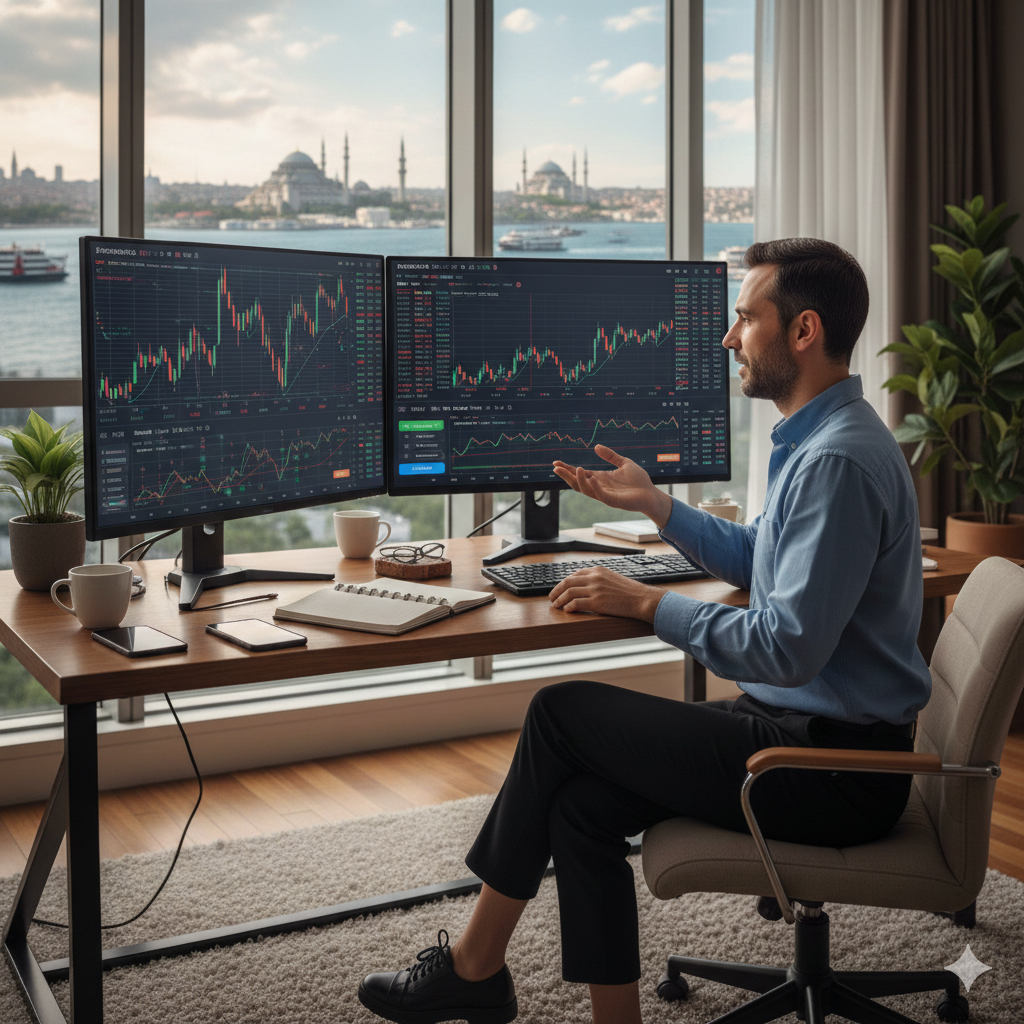
Introduction to Forex Trading
The Forex trading market, often referred to as forex or FX, is the largest and most liquid financial market globally. With a staggering $9.6 trillion traded every day, it far surpasses other markets in both size and activity. For context, the daily trading volume of the S&P 500 is only about $4.95 billion, which is just a tiny fraction of what happens in forex.
Forex trading involves buying one currency while simultaneously selling another. Unlike traditional stock markets that operate through centralized exchanges, forex is a decentralized global network where banks, financial institutions, corporations, and individual traders engage in trading around the clock.
What Is Forex?
At its essence, forex trading is about exchanging one currency for another. Each transaction involves a currency pair, where traders predict price movements between two currencies to make a profit. For instance, when you travel and exchange your home currency for the local currency, you’re engaging in the forex market, even if it’s on a basic level.
How does Forex Work?
In Pakistan, forex trading occurs through recognized banks, brokers, and financial institutions. Unlike platforms like the Pakistan Stock Exchange (PSE), forex transactions are conducted over-the-counter, meaning they happen directly between parties in different time zones. The market operates 24/5 across major financial centers like London, New York, and Tokyo, allowing traders to speculate on currency fluctuations at any time.
The forex market is open continuously, operating 24 hours a day, five days a week. This is made possible by the overlapping time zones of the four major trading hubs: London, New York, Sydney, and Tokyo. When one market closes, another opens, ensuring a constant flow of trading opportunities throughout the week.
Understanding Currency Pairs
In forex, currencies are always traded in pairs. You can’t speculate on the value of a single currency by itself; it must be compared to another currency. Each currency is identified by a three-letter code known as the ISO 4217 Currency Code. The first two letters indicate the country, while the third letter represents the currency name.
The EUR/USD currency pair represents the euro against the US dollar, while GBP/JPY shows the British pound compared to the Japanese yen, and AUD/CAD indicates the Australian dollar versus the Canadian dollar. Each currency pair consists of two parts: the base currency, which is listed first and is always valued at one, and the quote currency, which tells you how much of that currency is needed to buy one unit of the base currency.
Currency pairs fall into three main categories:
Major Pairs: These are the most traded pairs, making up about 85% of the total forex trading volume. They always include the US dollar and represent the largest economies globally. Examples of major pairs are EUR/USD, USD/JPY, GBP/USD, USD/CHF, USD/CAD, and AUD/USD. Notably, the EUR/USD pair accounts for roughly 25% of all forex transactions. Major pairs usually have the tightest spreads, making them more economical for traders.
Minor Pairs
Also known as cross pairs, these combinations do not include the US dollar. Examples are EUR/GBP, GBP/AUD, EUR/CHF, and CAD/JPY. Although they exclude the USD, they still involve currencies from significant economies. Minor pairs typically have wider spreads than major pairs due to lower trading volumes.
Exotic Pairs
These consist of a major currency paired with a currency from a developing economy or a smaller nation. Examples include USD/MXN (US dollar against the Mexican peso), USD/THB (US dollar against the Thai baht), and GBP/SEK (British pound against the Swedish krona). Exotic pairs tend to have the widest spreads and come with higher risks due to potential economic and political instability in some countries, but they can also offer greater rewards for seasoned traders.
Why People Trade Forex
There are several compelling reasons why traders are drawn to the forex market:
Speculation on Currency Movements
For many forex traders, the main goal is to profit from changes in currency values. They analyze economic indicators, political events, and market sentiment to forecast whether a currency will gain or lose strength against another. For instance, if you think the euro will appreciate against the US dollar, you would buy EUR/USD. If your prediction is correct and the euro rises, you stand to gain from the increase in price.
Hedging Against Risk
Businesses and investors often turn to forex to protect themselves from currency risk. For example, a company expecting to receive payments in a foreign currency might use forex to shield itself from unfavorable exchange rate shifts. Additionally, traders can use currency correlations for hedging. Pairs like EUR/USD and GBP/USD typically move in tandem, so traders might take opposite positions to mitigate potential losses.
Market Accessibility
Unlike stock markets that have set trading hours, the forex market is highly accessible. It operates 24 hours a day, five days a week, allowing traders to take advantage of opportunities whenever they arise. Some brokers even provide weekend trading for certain currency pairs. This flexibility makes forex especially appealing to those who can’t keep an eye on the markets during regular business hours.
High Liquidity
The vast daily trading volume in forex results in remarkable liquidity, enabling traders to enter and exit positions swiftly with minimal price slippage. This liquidity is particularly evident in major currency pairs, which are continuously traded around the world.
Factors That Move the Forex Market
To succeed in forex trading, it’s essential to understand what drives currency prices. Several key factors influence market movements:
Central Bank Policies
Central banks have a major impact on currency values through their monetary policy choices. When a central bank changes interest rates, engages in quantitative easing, or introduces other policy measures, the effects on the currency can be significant. Generally, higher interest rates tend to strengthen a currency because they attract foreign investments looking for better returns, while quantitative easing, which boosts the money supply, often leads to a weaker currency.
Economic Data and Reports
Economic indicators like GDP growth, employment statistics, inflation rates, and manufacturing data play a crucial role in determining currency values. A strong economic performance usually increases demand for a country’s currency as investors aim to take advantage of growth opportunities. On the other hand, poor economic data can lead to a decline in currency value.
Political Events and Stability
Political events, elections, policy shifts, and geopolitical tensions can lead to considerable currency fluctuations. Investors typically favor stable political climates and are more likely to invest in currencies from countries with solid governance and reliable policies.
Market Sentiment
The psychology of traders and overall market sentiment are vital in forex trading. When traders collectively anticipate that a currency will move in a certain direction, their trading actions can create a self-fulfilling prophecy. Factors like news events, discussions on social media, and predictions from analysts all shape the prevailing market sentiment.
Key Forex Trading Concepts
Pips and Pipettes
A pip, or percentage in point, is the standard unit for measuring price movements in currency pairs. For most pairs, a pip indicates a one-digit change in the fourth decimal place. For instance, if EUR/USD shifts from 1.1050 to 1.1051, it has moved one pip. In pairs that include the Japanese yen, a pip is measured in the second decimal place. A pipette is an even finer measurement, representing movement at the fifth decimal place.
When it comes to Forex trading, understanding lots and position sizing is crucial. Forex is traded in standardized units known as lots, with a standard lot representing 100,000 units of the base currency. Since currency movements are often minimal, these larger lot sizes help traders achieve significant profits. For those looking to manage risk more effectively or accommodate various account sizes, mini lots (10,000 units) and micro lots (1,000 units) are also available.
Day Trading
Day traders focus on buying and selling all their positions within the same trading day, which helps them avoid the risks associated with holding trades overnight. They closely monitor short-term price movements and often use technical analysis to make quick decisions, executing multiple trades based on the fluctuations they observe throughout the day. This type of trading demands a significant time investment and a disciplined approach.
Swing Trading
Swing traders, on the other hand, maintain their positions for several days or even weeks, aiming to capitalize on medium-term price movements. This strategy involves trading less frequently compared to day trading or scalping and combines both technical and fundamental analysis to spot potential trading opportunities.
Position Trading
Position traders adopt a long-term perspective, holding onto their trades for weeks, months, or sometimes even years. Their primary focus is on fundamental analysis, economic trends, and significant market developments, rather than getting caught up in short-term price changes. This method requires a great deal of patience and a strong belief in their analysis.
Risk Management in Forex Trading
To succeed in forex trading, it’s essential to implement effective risk management strategies:
Stop-Loss Orders
Stop-loss orders are designed to automatically close a position when the price hits a predetermined level, which helps limit potential losses. Setting the right stop-loss levels is vital for safeguarding capital and avoiding emotional decisions during times of market volatility.
Take-Profit Orders
Take-profit orders work similarly by automatically closing positions once they reach a specified profit target, ensuring that gains are secured before any market reversals can take place.
Position Sizing
Choosing the right position sizes based on your account balance and risk tolerance is crucial to avoid significant losses. Many seasoned traders recommend risking no more than 1-2% of their account on any single trade.
Diversification
Spreading your investments across different currency pairs or avoiding over-concentration in correlated pairs can help mitigate risk across various market conditions and economic scenarios.
Getting Started with Forex Trading
Education and Preparation
Before putting real money on the line, those interested in forex trading should dedicate time to learning. Grasping the basics of market mechanics, technical and fundamental analysis, and risk management is essential for successful trading. Many brokers provide educational materials, webinars, and courses tailored for beginners.
Demo Trading
Reputable forex brokers typically offer demo accounts with virtual money, allowing traders to practice without any financial risk. These demo accounts simulate real trading conditions, giving users valuable experience with trading platforms, order execution, and market analysis tools.
Choosing a Broker
It’s crucial to select a trustworthy and regulated forex broker. Important factors to consider include regulatory oversight, trading costs (like spreads and commissions), the range of currency pairs offered, platform features, customer support, and options for deposits and withdrawals. In the UK, traders should seek brokers regulated by the Financial Conduct Authority (FCA).
Platform Selection
Today’s forex trading platforms come with a variety of features such as real-time charts, technical indicators, news feeds, and automated trading options. Well-known platforms include MetaTrader 4, MetaTrader 5, and various proprietary web-based platforms. Mobile applications also allow for trading on the go, offering flexibility for active traders.
Understanding Forex Market Structure
Over-the-Counter Market
Unlike stocks that are traded on centralized exchanges, forex functions as an over-the-counter (OTC) market. This means that trades happen directly between parties through a global network of banks, financial institutions, and electronic trading systems. There is no central exchange or physical location where all forex transactions occur.
Market Participants
The forex market is made up of a variety of players, including central banks that oversee monetary policy, commercial banks that handle transactions for businesses and individuals, hedge funds and institutional investors looking to make profits, multinational corporations managing their currency risks, and retail traders who speculate on currency fluctuations.
Market Sessions
The forex market operates around the clock and is divided into four main trading sessions: Sydney, Tokyo, London, and New York. The highest trading activity and volatility usually happen when major sessions overlap, especially during the London-New York overlap.
Tax Considerations
The way forex trading is taxed can differ depending on the country. In many places, profits from forex trading are treated as taxable income. Some regions allow traders to offset losses against other income, while others have specific regulations for speculative versus hedging activities. It’s advisable for traders to consult with tax professionals to fully understand their responsibilities and keep accurate records of all their trades.
Common Mistakes to Avoid
Overleveraging
One of the most frequent and risky mistakes traders make is using too much leverage. While it can boost profits, it can also significantly increase losses and quickly drain trading accounts.
Lack of Trading Plan
Trading without a solid strategy often leads to emotional decisions and inconsistent outcomes. Successful traders create and adhere to well-structured trading plans.
Ignoring Risk Management
Not using stop-loss orders, risking too much on individual trades, or overlooking proper position sizing can lead to significant losses that could have been avoided.
Chasing Losses
Trying to recover losses quickly by increasing trade sizes or making impulsive trades usually worsens the situation instead of fixing it.
Overtrading
Engaging in too many trades, particularly out of boredom or compulsion, raises transaction costs and often results in poor decision-making.
Foreign Exchange
From the very beginning, trading platforms have been involved with foreign currency pairs, tracing back to ancient trading practices in Egypt. Forex, short for Foreign Exchange, serves as the backbone of the global financial system. In 2022, the average daily trading volume in forex reached an astounding $7.5 trillion, according to the Bank for International Settlements Triennial Survey report, making it the largest and most liquid financial market in the world. This market saw a 14 percent increase from its previous valuation of over $6 trillion in 2019. A recent report from the New York Foreign Exchange Committee (October 2024) highlighted that over-the-counter (OTC) forex trading had a valuation of about $1,196 billion per day, which includes spot trading, swaps, and options.
In Pakistan, SECP-regulated forex trading platforms provide a legitimate way to engage in currency derivatives. While direct trading in foreign currency pairs is prohibited, Pakistani traders can still participate through licensed brokers and regulated channels.
So, what makes forex trading so appealing? In this article, we will explore the ins and outs of forex trading, how it operates, the various types available, and some challenges you might face, giving you a clearer understanding of the market.
A brief introduction to the forex market reveals that it is a platform for buying and selling currencies without a central exchange, which is why it is considered the most reliable financial market worldwide. Traders can profit from price fluctuations between different currencies, thanks to the 24/7 trading schedule that attracts a diverse range of investors, from individuals to large institutions.
With features like hedging, high liquidity, leverage, and easy market access, forex presents countless opportunities to take advantage of the ever-changing currency landscape.
The Future of Forex Trading
The forex market is constantly changing due to advancements in technology. More and more, traders are using artificial intelligence and machine learning for market analysis and automated trading. The integration of crypto currencies is also on the rise, with crypto-fiat pairs becoming increasingly common. Additionally, mobile trading is expanding, making forex more accessible than ever before.
Regulatory frameworks are adapting as well, with authorities around the world implementing stricter rules to protect retail traders. These changes aim to enhance transparency, ensure fair pricing, and prevent fraudulent activities.
Forex Trading Important Factors To Vonsider
Currency pairs
Each currency has a three-letter code, such as USD for the US Dollar, EUR for the Euro, GBP for the British Pound, CAD for the Canadian Dollar, and JPY for the Japanese Yen. Currencies are always traded in pairs.
Spreads
This refers to the difference between the bid (buy price) and ask (sell price). For you to make a profit, the market price must move in your favor beyond this spread.
Leverages
This tool allows traders to control larger positions with a smaller initial investment. While leverage can significantly increase potential profits, it also raises the risk involved.
What types of forex markets exist?
Forex trading is divided into several categories:
The spot market
In this market, currencies are exchanged “on the spot,” meaning transactions are typically completed within two business days. This makes the spot market nearly instantaneous for trading currencies at current market prices.
Forward market
Forward contracts allow you to lock in a price for buying or selling a currency at a future date. This helps protect against fluctuations in exchange rates.
Futures market
Similar to forwards, futures contracts are standardized in terms of amount, exchange rate, and settlement dates.
Options market
In this market, traders deal with currency options, which give you the right (but not the obligation) to buy (call option) or sell (put option) a currency pair at a predetermined price before a specific date.
By understanding these different types of markets, you can choose the one that best fits your investment strategy and risk tolerance.
Forex trading: Strategies and Techniques
There are several strategies tailored to different trading styles and goals that you can find on forex trading platforms:
Scalping: This strategy involves making quick trades over seconds or minutes to capitalize on small price fluctuations.
Day trading: This approach requires opening and closing positions within the same day, aiming to profit from intraday price movements.
Swing trading: This method focuses on capturing medium-term trends, holding trades for several days to weeks.
Position trading: This is a long-term strategy where trades are held for weeks or months, typically based on prevailing market trends.
Combining technical analysis with market action will guide you in making informed decisions about when to enter and exit trades in the forex market.
Risks and Challenges in Forex Trading
While forex markets can be profitable, it’s crucial to recognize the inherent risks involved in forex trading, such as high market volatility, market sentiment shifts, leverage risks, regulatory challenges, liquidity issues, and potential fraud. Additionally, currency pairs with low trading volumes may experience execution slippage, making it difficult to trade unless you are fortunate or willing to incur high transaction costs.
Understanding these factors, along with risk management and hedging strategies, can help you make more informed forex trading decisions. How to Start Forex Trading in Pakistan?
The forex trading market in Pakistan has been thriving and is part of a global trend. As of 2024, the forex market size in Pakistan was estimated to exceed $30 billion. Reports from organizations like the IMARC Group suggest that this figure could grow to nearly $66 billion by 2033, reflecting an 8.8 percent growth rate. This growth is partly driven by an increase in remittances from non-resident Indians (NRIs) and rising foreign investments in various sectors, including IT and business services.
Conclusion
Forex trading presents significant profit opportunities, but it also comes with considerable risks. Achieving success in this field requires thorough education, disciplined risk management, ongoing learning, and realistic expectations. The market’s vast size, liquidity, and accessibility attract traders globally, but these same factors contribute to a highly competitive landscape.
Aspiring traders should approach forex with caution, beginning with education and demo trading before investing real money. It’s crucial to understand market mechanics, create a solid trading plan, and maintain strict risk management practices for long-term success in the forex market.
Whether you’re interested in forex for speculation, hedging, or diversification, keep in mind that consistent profitability demands dedication, patience, and the ability to adapt to changing market conditions. The foreign exchange market rewards those who engage with it respectfully, prepared, and committed to continuous learning.
FAQs
1. Can I start a forex account in Pakistan?
Yes, you can. For opening a forex trading account in Pakistan, you need to select a broker registered with SECP to ensure safe trading.
2. What are the authorized derivatives in forex?
In Pakistan, forex trading in authorized platforms is restricted to currency pairs like USD/INR, GBP/INR, JPY/PKR, and EUR/PKR.
3. What does 5-3-1 test mean for forex?
Five currency pairs are to be focused on, three will be used for trading; then one point of time will be used for trade. This is to maintain the consistency of trades, having minimum risk and maximum returns.