TurboTax and TaxAct are two of the top tax preparation apps I’ve tried, each with its own strengths. Let’s take a look at how they stack up in terms of pricing, features, ease of use, expert assistance, and more. Intuit TurboTax, which has won the Editors’ Choice award, and TaxAct, a favorite among readers for paid tax software, have both been around for over thirty years, and I’ve been reviewing them for a good part of that time. They handle both simple and complex tax returns effectively and provide valuable insights to help you reduce your tax bill. You don’t need to be a tax pro to navigate them, but it’s essential to understand some key differences before you start preparing your taxes for 2025. After thorough testing, I’ll compare TurboTax and TaxAct across several important categories, including cost, mobile accessibility, support for various tax topics, and more, to help you choose the right one for your situation.
Price: TaxAct Generally Undercuts TurboTax
Both TaxAct and TurboTax are pretty expensive. They have free versions for federal taxes that work for simple TaxAct and TurboTax situations. TaxAct and TurboTax have these versions but they only work for federal taxes and some basic tax stuff.
TaxAct charges you $39.99 for each state return you need to file. Turbotax has a free version for state returns too. This is a difference between TaxAct and TurboTax.
37 Percent of people who file taxes can use TurboTax Free Edition, which includes simple Form 1040 returns but no other forms except for a few things like EITC and CTC and student loan interest and Schedule 1-A.
The paid versions of TaxAct cost between $29.99 and $74.99 and you need the most expensive one if you are self-employed or have a small business and need to file Schedule C with TaxAct. You also have to pay $39.99 for each state return, with TaxAct.
TurboTax has two paid versions, Deluxe and Premium which cost $49 and $99 and each state return costs $39 with TurboTax. You have to get the Premium version of TurboTax if you’re self-employed or have a small business and need to report advanced tax stuff.
All of these prices will go up later in the tax season so TaxAct and TurboTax will cost more. The expensive versions of TaxAct and TurboTax will cost $109.99 and $139.99 and state filing will cost $64 with TurboTax.
You do not have to pay for TaxAct or TurboTax until you are ready to file your taxes so you can try them out. See which one you like better, TaxAct or TurboTax. When you start your taxes does not matter, because TaxAct and TurboTax will always charge the price unless they have a special deal.
Interface and Ease of Use: A Matter of Taste
I think about the TaxAct service and how easy it is to use. I do not just look at how nice the TaxAct service looks I also think about how easy it’s to get around the TaxAct website. The TaxAct service has to be easy to use. It has to work well.
The new TaxAct website is better because it does not have many extra pages. It is also easier to find what I need on the TaxAct website. I like that the TaxAct service is simple and easy to use. The TaxAct website looks nice. It is easy to read. The people who made the TaxAct website chose fonts and layouts. This makes the pages on the TaxAct website look good. It is easy to find what I need. The TaxAct service seems faster, than TurboTax when I used it.. There are a lot of things that can make a website seem slow or fast.

TurboTax’s user experience has always been great. The text is a bit lighter. Can be harder to read than TaxAct’s but the fonts, page layouts and occasional graphics make it look really good. The navigation cues are always clear and easy to understand. However TurboTax does not have TaxAct’s tax topic directory that appears at the start of the Federal section.
Evaluating a site’s user experience can be a bit subjective. Usability is always important. You might prefer TurboTax’s more visually appealing look over TaxAct’s serious approach.. You might like TaxAct’s approach better.
Walk-Throughs: TurboTax Makes Things Easier
TurboTax makes things smoother, with its interviews and walk-throughs. They guide you through the tax filing process. TurboTaxs interviews are very helpful. They ask you questions. Fill out the forms for you. This makes it easier to do your taxes.
Both TaxAct and TurboTax take a hybrid approach in helping you complete the 1040, using a combination of tax topic lists and wizard-like tools. They roughly follow the path of the 1040, asking questions and allowing you to provide your answers by checking boxes, entering data, and selecting options from lists. Both handle the mechanics of the interview capably and use clear, understandable language, not stilted IRS talk. TurboTax is more casual and conversational, and it handles transitions between sections more seamlessly, so it feels like one lengthy interview. TaxAct is choppier.
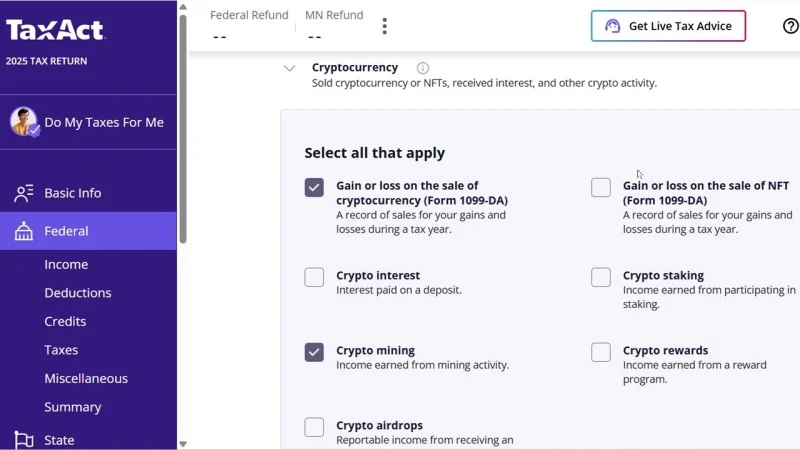
TaxAct offers to walk you step by step through the whole process, which is an advantage, especially if you are inexperienced or have a complex return. You can also opt to just select the topics you need from the lists provided, complete the mini wizard for that topic, and return to the list. TurboTax supports this method, which can reduce your tax prep time—so long as you’re certain you can identify every tax topic you need to visit.
TaxAct allows you to jump ahead in the interview without completing the current one, unlike some competitors. This approach might cause you to miss tax topics you need, though the software should flag incomplete topics in its final review.
Both sites strive to save you time. For example, on some lengthy forms, TaxAct displays only the fields you are most likely to need and then asks whether any others apply. If so, it opens them. Otherwise, you can just move on. TurboTax now allows you to select an estimated dollar range for possible deductions, such as medical expenses. If you clearly have no chance of itemizing, it tells you the standard deduction is your best option, which can save you some data entry time.
Finally, the ability to import data from external sources is vital; it saves time and reduces errors. TurboTax is more comprehensive and flexible when it comes to important tax documents, such as Form 1099B. You can bring in data directly from financial institutions or via a scanned file upload. If you’re tracking financial transactions in Credit Karma (which Intuit owns), you can import that data directly into TurboTax.
Tax Topic Coverage: Each Is Comprehensive
When you start with these services they help you pick the tax topics that’re relevant to your money situation. They ask you a bunch of questions to figure out which categories apply to you. But do not worry every topic is still available if you need it. They break down the 1040 form into parts, like income, deductions and credits and taxes. Under each part they show you a list of tax topics. For example dividend income, medical and dental expenses and self-employment income.
Both TaxAct and TurboTax support all the IRS forms and schedules and most of the smaller ones too. So most people should be able to finish their tax returns with either one. When I tried them out I found that TurboTax goes into detail in both common and not so common tax areas.
If you look closely at the lower left corner of TaxAct near the bottom of the toolbar you will find two very useful tools. The Forms Assistant and the Topics Assistant are really helpful when you need to find a form or topic or even page. I think it would be better if these tools were easier to see. TurboTax also has a list of topics that you can search but it is hard to find in the toolbar.
Help Resources: TurboTax Has Support
Both TaxAct and TurboTax have many ways to help you. They have help for questions about how the website works and you can ask for help by chat, email or phone. As you go through the tax questions they explain things in a way that’s easy to understand. You can also search for answers to your questions in their database. Sometimes you can even talk to a chatbot. Both TaxAct and TurboTax let you talk to a tax professional by chat or phone if you have questions, about your taxes. You have to pay extra for this. TaxAct and TurboTax do not just give you the instructions that the IRS gives you. They have rewritten the instructions to make them easier to understand.

Recommended by Our Editors
When I evaluate a tax service, I pay close attention to how accessible, detailed, and extensive their online guidance is. In this regard, TurboTax stands out. The app provides exceptionally clear and engaging explanations of tax topics across all its support levels. It introduces financial concepts as you navigate through the interview process and offers links to additional resources. These links lead to context-sensitive articles and how-to guides displayed in a vertical pane, along with direct links to relevant topic pages when necessary. Compared to TaxAct, TurboTax’s interview feature includes more of these helpful links and offers more explanatory text in the Q&A sections.
You can also use TurboTax’s search box to look up answers to your questions. My experience with this feature was mixed. Sometimes it returned multiple results, some of which were relevant to my search terms. However, I found that using the TurboTax AI Assistant yielded better, more targeted results. This assistant engages in conversation and suggests follow-up questions, learning from your interactions—something the traditional search tool lacks. During my testing, it provided accurate and direct responses to my inquiries.
When using both tools, the quality of your results really hinges on how specific your question or phrase is. It’s also important to consider where your answers are coming from. I’ve previously pointed out that TurboTax tends to rely on responses from community members instead of their own staff, and I still feel that way. TaxAct has a similar range of core help tools, but, as I mentioned, it doesn’t include as many helpful links within the Q&A sections. When it does provide links, they sometimes open in a way that covers the interview page, which can be frustrating. More comprehensive guidance would be appreciated across the entire site, particularly on pages that tackle more complex topics. Unfortunately, the site still occasionally sends you to IRS publications and doesn’t utilize AI in a dedicated search tool.

TaxAct does something that TurboTax does not do. When you have the side of the screen open and it is empty TaxAct gives you information that changes as you go through the different screens. I did not see this happen a lot. It works sometimes. This part of the screen also has instructions for the forms links to things the Internal Revenue Service has published and the Tax Glossary.
TaxAct is also better at looking over your tax return and finding mistakes and things that are missing. It does a job of showing you only the parts that need to be fixed and then moving on to the next one until you have fixed everything. TurboTax also took me to the place where I could enter the missing cost of supplies in the part about business expenses. For some reason it also showed me a long worksheet for Schedule C that I did not need to use and could not change. TaxAct and TurboTax are different in this way. TaxAct is good, at helping you fix mistakes in your tax return.
Mobile Access: TurboTaxs Good Things Are The
TurboTax and TaxAct are both very good when you use them on your phone. TurboTax has an app that you can download on your Android or iOS phone. TaxActs website works well on screens. You can do everything on your phone that you can do on your computer. This means you can even file a tax return that needs a lot of forms.
TaxAct is very good at checking your tax return when you are done and helping you fix mistakes. TurboTax is easier to look at on a screen and it has better help. Because the phone version is the same, as the computer version TurboTax is a little better.
How Do You Want to File Your Taxes?

Intuit TurboTax 2026 (Tax Year 2025)
I really think both TaxAct and TurboTax are choices for the 2025 tax year.. If I had to pick one I would say TurboTax is better. The reason is that TurboTax has help when you need it. It is also easier to use when you are answering the tax questions. TurboTax can import your information from places more easily.. It looks a little nicer on your phone. If you are eligible you can even file your state taxes without paying anything. That being said, if you already like TaxAct and want to save some money it is still a choice. Some people will like TaxAct better because it is more serious.. If you are new to filing taxes I think TurboTax is the way to go. TurboTax is just easier to use and understand, which is why I think it is better than TaxAct, for people.