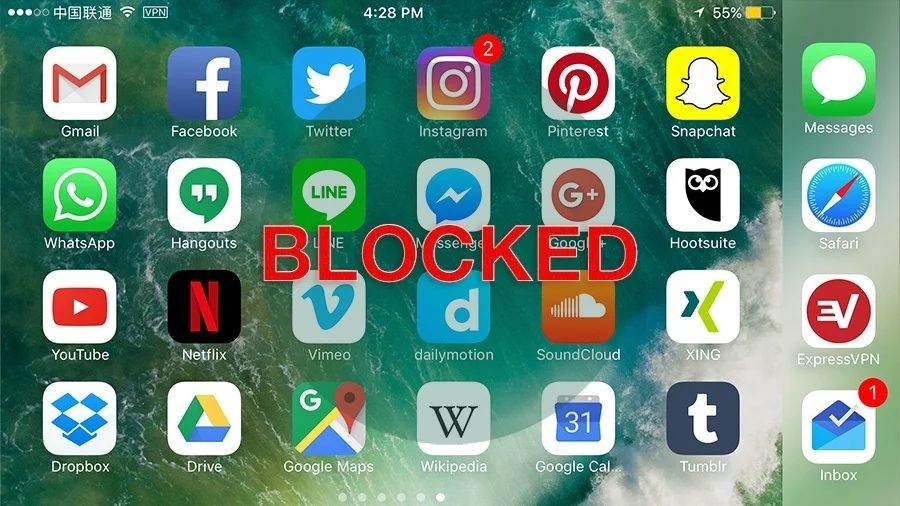
Apps are blocked In China, you won’t hear the phrase “Just Google it.” Similarly, Google Maps won’t help you navigate the bustling streets of Beijing, and you can’t access your Gmail to check for new messages. This is all due to strict internet censorship and stringent government regulations.
So, why is Google blocked in China? There are countless URLs that are inaccessible in mainland China, with various Google services being among the most notable. The Chinese government employs website blocking as a method to control the internet within its borders. This extensive set of laws and actions is known as The Great Firewall of China, which is one of the most comprehensive systems ever established for censoring the internet.
The Great Firewall of China apps are blocked
The Great Firewall (GFW) is part of the Golden Shield Project, which encompasses various aspects of China’s national network security. Its main goal is to regulate Internet access within China, allowing only content that aligns with strict government policies. This is accomplished through blocking certain websites, filtering keywords, and monitoring Internet users’ activities.
A complex surveillance system makes this control possible. The technical methods employed to manage Internet content include IP blocking, URL filtering, Man-in-the-Middle attacks (MITM), DNS filtering, and more.
The Chinese internet police, made up of tens of thousands of individuals, continuously oversee online discussions and publications to suppress dissenting opinions and remove content that is unfavorable to the authorities. Those who criticize the regime, engage with foreign groups, sign petitions, or express views on sensitive topics risk prosecution and even imprisonment.
Freedom House, which publishes annual reports on “Freedom on the Net” and ranks countries accordingly, has labeled China as “the worst abuser of Internet freedom.” In their 2021 report, they noted that the Chinese government’s control has intensified significantly during the global COVID-19 pandemic.
What websites are restricted in China?
The Chinese government exercises strict control over which information sources are accessible, including apps. Often, apps and websites can only remain available if they comply with government regulations. This overview will give you an idea of what you can access while in China. Keep in mind that this list highlights only some of the most popular sites and apps in various categories. Additionally, the accessibility of these sites may change as both the apps and the government’s policies evolve. If you have a specific site or service in mind that you might need while in China, it’s a good idea to verify its accessibility before your trip.
Social Media apps are blocked
China’s Great Firewall restricts access to a growing number of social networking platforms. Occasionally, some previously banned sites, such as LinkedIn, may become accessible again.
News and information apps are blocked
- In China, many Western news sources are blocked, making it difficult to access international news. The only readily available information comes from state-owned or state-approved outlets. Here are some of the news websites you can expect to be inaccessible in China:
- · New York Times
- · The Financial Times
- · The Economist
- · The Wall Street Journal
- · Bloomberg
- · Google News
- · Wikipedia
Media outlets apps are blocked
A significant number of Western entertainment and media websites are inaccessible in China. Here’s what you could be missing:
Search engines apps are blocked
- Search engines in China are heavily controlled, which explains why many of them face censorship. While some search engines might still be available, the results you get can vary significantly when you’re in China. Others, like Google, have been completely banned. Google is currently exploring ways to reenter the Chinese market, but doing so would mean changing the way they present their search results.
- · Google Search
- · Bing
- · Yahoo
- · DuckDuckGo
Messaging apps apps are blocked
- Messaging apps face similar limitations. Those that refuse to provide access to the Chinese government are often banned, which effectively eliminates options for privacy-focused and security-conscious messaging apps.
- · Messenger (and Facebook)
- · SnapChat
- · Telegram
- · Signal
Why are certain websites blocked in China apps are blocked
The Chinese government has the authority to restrict or block applications and websites that do not align with its regulations. In this context, “alignment” often involves censoring or removing content that doesn’t meet government standards. The specific sites and services that are blocked can change over time, reflecting the government’s total control over information.
For instance, a website might choose to comply with Chinese laws, or the laws themselves might evolve, affecting the status of various sites. Take Google, for example; it operated in China until 2010, attempting to cater to the local market while adhering to censorship policies. However, after experiencing a cyber attack traced back to China, Google decided to redirect its Chinese users to its Hong Kong search engine, where such censorship was not enforced. Unsurprisingly, this led to Google’s services becoming unavailable to users in China.
Another case is the AI chatbot ChatGPT, which can hold conversations that feel natural and provide users with requested information. However, China has blocked this chatbot, citing security concerns and claiming that it could be used by the US to disseminate misinformation.
How to access websites while in China apps are blocked
Accessing websites while in China can be challenging due to The Great Firewall, but using a VPN is a common solution. A VPN works by rerouting your internet traffic through a remote server, effectively changing your IP address. This allows you to appear as if you are in a different location, helping you bypass local restrictions and censorship. It’s crucial to select a trustworthy VPN provider with robust technical features, such as a variety of VPN protocols, to navigate the stringent internet landscape in China—NordVPN is a great example. One of its protocols, the NordWhisper protocol, is particularly useful in cases where VPN connections might be blocked on local networks.
Since downloading VPNs can be tricky or even impossible while in China, it’s advisable to set one up before your trip. With its extensive security features and strong encryption, NordVPN is an excellent choice for expats, journalists, travelers, and anyone planning to spend time in China.
